
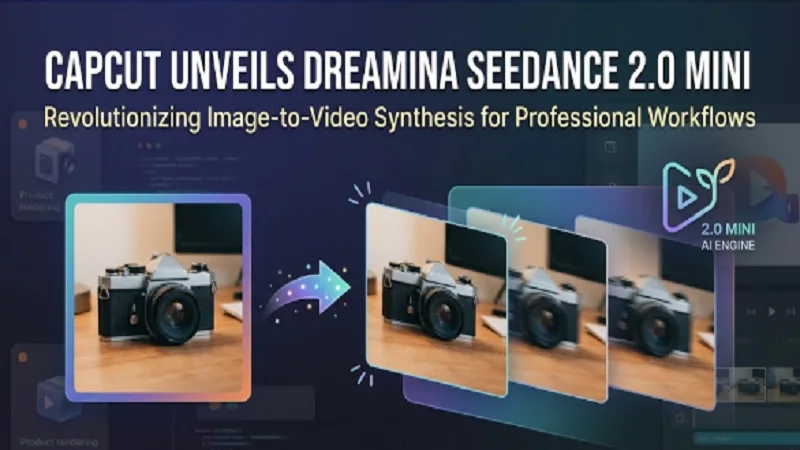
LOS ANGELES, CA — As the demand for highly engaging, hyper-personalized short-form video content continues to accelerate across global digital landscapes, the tools powering creative workflows are undergoing a massive foundational shift. Addressing the critical industry need for higher visual fidelity, structural continuity, and more natural motion sequences, CapCut has announced its latest advancement in generative artificial intelligence: the official release of the Dreamina Seedance 2.0 Mini image to video engine. This model upgrade introduces sophisticated architectural enhancements designed specifically to bridge the historical gap between static graphic design and dynamic, cinematic video production.
The newly optimized Dreamina Seedance 2.0 Mini focuses heavily on temporal consistency and multi-frame structural integrity, directly solving common industry pain points such as pixel clipping, structural warping, and micro-jitter that frequently plague first-generation AI video platforms. By delivering highly localized motion controls and fine-grained rendering, the update provides independent creators, digital marketing agencies, and media studios with an accessible, high-efficiency entry point into automated visual storytelling.
Technical Innovation: What Powers the 2.0 Mini Upgrade?
In the rapidly evolving landscape of generative artificial intelligence, moving from a static picture to a fluid, moving video requires immense computational precision. The underlying architecture of the Dreamina Seedance 2.0 Mini AI video generator utilizes advanced deep diffusion models specifically tuned to recognize and respect physical properties within a source image. Whether identifying the delicate texture of a fabric, the weight and fluid dynamics of water, or the complex geometry of a human face, the engine maps out consistent physical behavior across every generated frame.
Traditional tools often struggle to maintain subject details when introducing camera pans, tilts, or complex character actions. The 2.0 Mini framework mitigates this by utilizing an advanced frame-prediction model that ensures background environments remain stable and unwarped while foreground elements execute precise paths of motion. This delicate balance between environmental stability and kinetic freedom allows for a significantly more natural-looking output, drastically reducing the time creative teams spend re-generating assets due to visual artifacts or structural collapses during rendering.
Optimizing Creator Value and Workflow Efficiency
For modern production houses and fast-paced digital content creators, time remains the most valuable resource. The implementation of the Dreamina Seedance 2.0 Mini image to video workflow addresses severe bottlenecking during the pre-production, prototyping, and ideation phases of content creation. Instead of building complex motion graphics from scratch or conducting costly, time-consuming reshoots for simple visual b-roll, editors can now convert concept art, photography, or brand graphics into high-definition video assets within a fraction of the traditional timeline.
- Render Optimization: The “Mini” designation highlights a highly efficient, lightweight model architecture that optimizes server-side processing queues. This allows users to rapidly prototype multiple visual concepts simultaneously without massive local hardware dependencies or long rendering wait times.
- Asset Repurposing: Creative agencies can breathe new life into vast libraries of existing static assets. Marketing portfolios, historical photographs, and vector product designs can be transformed instantly into dynamic video components for multi-platform distribution.
- Intuitive UI Integration: Operating directly within the modern CapCut ecosystem, the interface allows creators to quickly input an image, specify precise motion parameters via text or preset controls, and execute the generation without managing complex code or specialized scripts.
Practical Application Across Industries
The utility of a streamlined image-to-video pipeline extends across multiple commercial sectors. Because the tool does not require complex local rendering pipelines or vast historical training sets from individual users, onboarding takes minimal effort across different professional environments.
1. Digital Marketing and E-Commerce
In a crowded digital marketplace, static advertisements see significantly less engagement compared to moving media. Brands can utilize the tool to take standard studio product photography and generate elegant 360-degree rotations, dramatic lighting shifts, or contextual environmental motion. This dramatically lowers the cost of running multi-variant A/B tests for paid social media campaigns.
2. Social Content Creation
Social media algorithms consistently reward high-frequency publishing models. Content creators can utilize Dreamina Seedance 2.0 Mini text to video and image-to-video features to maintain a steady stream of highly polished aesthetic content, turning simple mid-journey concepts or photographs into eye-catching reels, shorts, and video essays without stepping away from their primary editing workspace.
3. Entertainment and Visual Storytelling
Indie filmmakers, authors, and conceptual artists face a historical hurdle when pitching projects or building storyboards. By generating moving mood boards that display accurate atmospheric adjustments—such as falling rain, drifting fog, or subtle cinematic head turns—producers can communicate complex creative visions to investors and stakeholders with unprecedented clarity.
Deep Dive: Enhancing Narrative Depth and Visual Fidelity
Beyond basic commercial utility, the True Value of the 2.0 Mini model lies in its nuanced handling of micro-expressions and environmental lighting. When processing human or character subjects, the engine avoids the rigid, artificial quality common in early AI videos. Instead, it introduces natural secondary movements—such as the subtle sway of hair or the realistic shifting of clothing folds in response to movement—which are vital for maintaining viewer immersion in narrative storytelling.
Furthermore, the lighting engine within the Dreamina Seedance 2.0 Mini dynamically calculates how light should interact with moving surfaces. If a character turns toward an implied light source, or if an object moves through an environment with varied illumination, the highlights and shadows update across the surface realistically. This attention to environmental coherence ensures that generated videos feel less like a series of manipulated layers and more like a singular, cohesive scene captured by a real camera lens.
Market Positioning and Future Outlook
The launch of the Dreamina Seedance 2.0 Mini signals a broader, permanent shift in how creative software suites view AI integration. Rather than treating machine learning as an external, novelty feature used for occasional experimentation, developers are treating it as a core, indispensable component of the modern editor’s toolkit. By focusing on a lighter, highly responsive model, CapCut makes professional-grade motion synthesis accessible to everyday creators who may not possess high-end computing arrays or extensive technical backgrounds.
As the industry moves deeper into automated video asset production, the emphasis is rapidly moving away from raw generation capacity toward structural control. The fine-tuning evident in this release demonstrates that maintaining the integrity of the user’s original image intent is just as critical as the movement itself.
About CapCut
CapCut is a leading all-in-one video editing platform designed to enable creative expression through accessible, intuitive, and highly capable editing tools. Trusted by millions of creators worldwide, the platform continuously pushes the boundaries of digital content creation by integrating advanced AI capabilities into everyday mobile, desktop, and web editing workflows.
Media Contact
- Contact Person: Ming Hu
- Email: capcutweb@bytedance.com
- Company Name: CapCut
- Product Reference: Dreamina Seedance 2.0 Mini See More